Overview
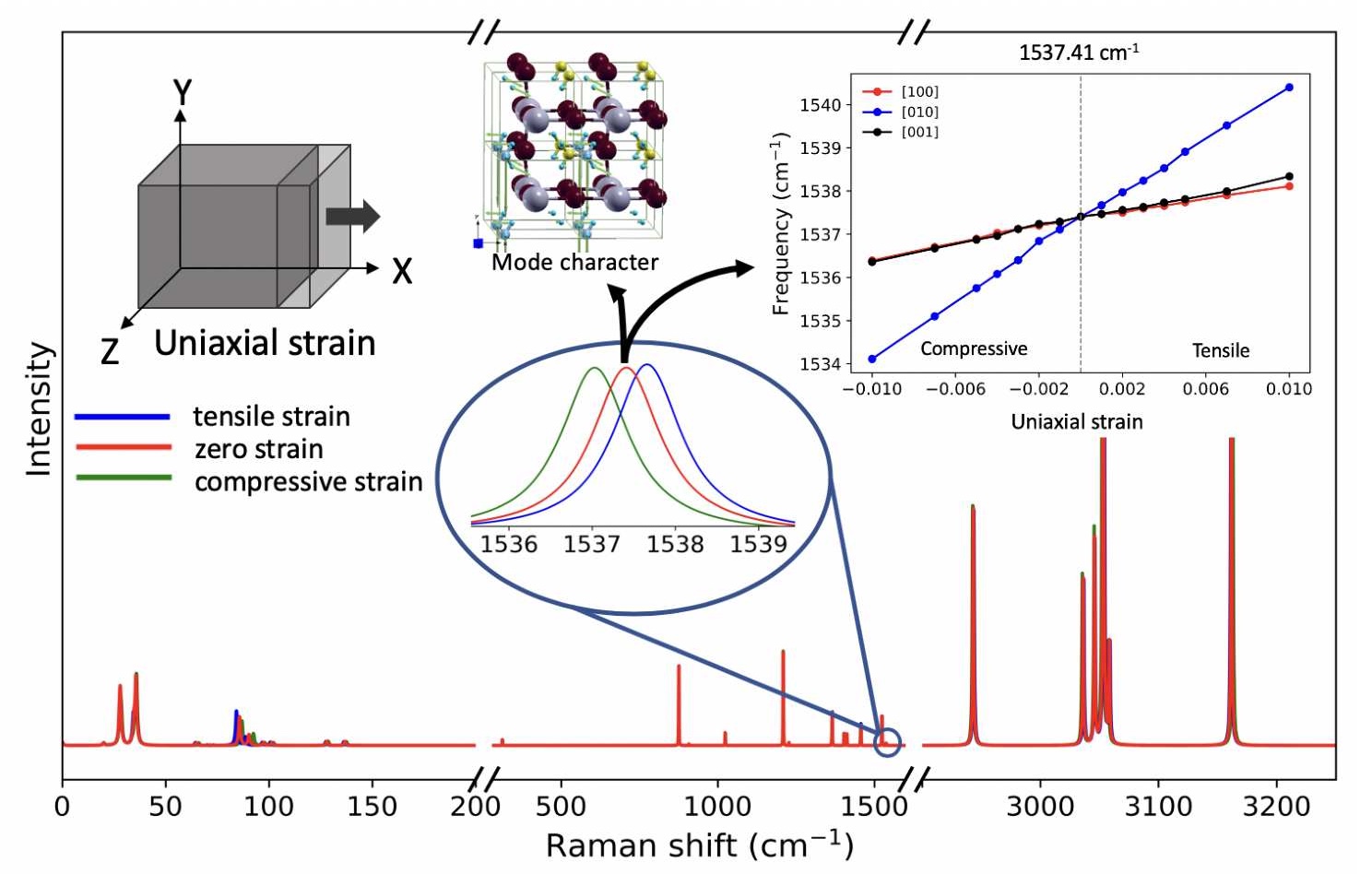
Inhomogeneous strain can affect carrier mobility, recombination, degradation, and photovoltaic performance, yet it is difficult to measure locally. This work uses first-principles calculations to identify strain-sensitive vibrational modes in pseudo-cubic methylammonium lead iodide and provides calibration curves for Raman or infrared microscopy.
Key resultFour modes near 86, 97, 1457, and 1537 cm⁻¹ provide practical local-strain probes for MAPI.
My contributionFirst-principles phonon calculations, strain calibration, mode analysis, and spectroscopy interpretation.
Research question
Which Raman and infrared modes can provide a reliable, spatially resolved measurement of local strain in CH₃NH₃PbI₃?
Approach
- Density-functional theory and density-functional perturbation theory in Quantum ESPRESSO
- Uniaxial tensile and compressive strain along three crystallographic directions
- Dynamical-matrix and phonon-eigenvector analysis
- Raman and infrared intensities, frequency–strain calibration, and mode Grüneisen parameters
What emerged
- Four modes near 86, 97, 1457, and 1537 cm⁻¹ were identified as promising probes of local strain.
- Linear shifts occur when the dynamical matrix changes without substantial change in the mode eigenvector; parabolic and irregular behavior reflect stronger eigenvector or structural changes.
- Strain changes Pb–I bond lengths and Pb–I–Pb angles, rotates the organic cation, and reveals lattice buckling.
- Directional Grüneisen parameters indicate anharmonicity and suggest unusual negative thermal expansion along [001].
Explain the work
Media and supporting material
This area is ready for a short video, selected presentation slides, figures, datasets, or an interactive explanation as the project page develops.
Project media
Video · slides · figures